
(6) Let’s Get Epic (Structure)
With Prompts

“The Great Enemy of Creativity is Fear.” ~ Faith Ringgold
Cheat Sheet for Aristotle’s 6 Elements:
PLOT (what) a representation (mimesis) of human action
w/a reason (telos) or goal for action
CHARACTER (who) action (we are what we do)
or character = metaphor of a human trying to do something
THOUGHT (why) the representation of the rational processes
of the characters/values/ideas articulated in the play
DICTION (how, dialogue) the way it’s conveyed
(acting, language choices)
SONG (when, rhythm of speech/music) and flow/interruption
SPECTACLE (where) what we see
These are not here so you can study them for some kind of test - there is no test! They are TOOLS! Here for you to use as you see fit. One way to use them is to make each one of them a lens, and go through your play (or any narrative you’re creating) and check it against each lens. That’s 6 ways to revise!
If you’re new, here are links to my earlier essays on the class I used to teach, “Structure is NOT a Dirty Word” Part 1 (on what is structure and your relationship to it); Part 2 (on Linear Structure and Non-Linear Trauma) Part 3 (on more Linear Structure and Events); Part 4 (with exercises to let the world into your writing) and Part 5 on Episodic Structure at the links!
We’ve looked at Structures Linear (Aristotelean, 3 Unities) and Episodic (Shakespearean, breaking the unities of time, space and action) and pretty much everything else is about working with Patterns and/or breaking them.
The more we become aware of the patterns we’re creating in our narratives, the more consciously we can explore our structures in intentional ways.
You might want to try a Circular form that ends where it begins, as in The Glass Menagerie. (I have two: Antigone’s Sister and Abraham’s Daughters.) The Circular form work well with memories because the protagonist is often beginning by looking back. Circular is more recently referred to as a Spiral form because by the end the protagonist is not exactly where they were at the beginning looking back; they have had a Moment of Recognition taking them to or toward a Transformation. If they started midway up a mountain and hiked up and around, by the end they might be looking at the same view, but from a higher vantage point with a new perspective.
OR you might want to create a play with an EPIC structure, like Bertolt Brecht or Caryl Churchill or Branden Jacobs-Jenkins (or my play MAN & WIFE) where:
time is often interrupted
space/place can be changed with a sign
meta, references to remind us we are in a theatre
reveals of the inner workings and backstage magic of theatre
use of song and spectacle in new ways
jarring shifts in tone or topic
Interruptions and jarring shifts are used to create distance between the play and the audience. Brecht called it verfremdungseffekt. Epic theatre tries to make things strange (also see Viktor Shlovsky). This strangeness keeps the audience from falling into the design or spell of the narrative. STOP! The way one falls into a delicious novel as if asleep to the world around them. NO! Epic Theatre refuses this trippy part of enjoying a story. Instead Epic Theatre keeps pulling the eyelids of its audience wide open! Usually to convey urgent social ideas in wild and weird ways.
Brecht’s Epic theatre created new patterns by breaking old patterns.
Or you might want to run a story BACKWARDS in Time like in Pinter’s Betrayal, a Linear structure with Time running backwards that makes Episodic Time- and Space-leaps but with a singular unity of Action. Betrayal is a great example of mixing and matching the stagecraft and structural elements at your disposal.
The more you see or read, the more aware you’ll be of all the different ways writers make use of the many possibilities. NPX is the cheapest way to have access to the most plays of today!
New patterns tend to arise when we, as dramatists, or any kinds of narrative writers, start to ask ourselves how can we tell the story the way we want to tell it or the way it seems to want to be told. If Pinter had told us the story of a marriage falling apart with a beginning-middle-end in that order, it might have felt boring or predictable. If he had decided there was one protagonist looking back within a Circular structure, he might have lost the opportunity to show us the scenes from beyond one protagonist’s perspective. So the story itself, and the way he wanted to tell it, conspire to give Pinter a way to create something new!
PROMPTS -
Here are a few ways to exercise how to use different patterns. Those 3 examples (Circular/Spiral, Epic, and Backwards) are just the beginning!
If you are content to work on Linear scenes, you are welcome to continue to work that way. YOU DON’T HAVE TO BREAK ANYTHING UNLESS YOU WANT TO!
And if you’re wondering, my play/narrative seems to want to _____, let’s explore!
If you have a stack of scenes you’re not properly pleased with, what happens when you change their order?
Let’s play with something short as an exercise (not a full-length play), so it’s easier to see how to handle some of these ideas. Then you can apply them, especially once you’ve used these muscles to make shorter work, to a larger narrative.
Start looking at the Elements (see above) and asking yourself some questions. For example Sarah Kane might have said, “Thought is supposed to be rational according to Aristotle, but what if I present Thought as irrational? What if Character is gone somehow, and Thought is left in an irrational state? What if I write a play called 4:48 Psychosis about someone having a psychotic break at 4:48 in the morning? What if I break Time? What if I break Character into random voices since that’s what this character-that’s-not-a-character hears? What if I refuse to use the convention of character designations in the script to show the fractured ‘non-character’ of a psychosis…” This is a way to work with the Elements.
Kane created a new pattern, and we have the language to discuss it. Structure offers us ways to hold the risks we want to take.
So let’s look at the Elements. Decide what element or elements to break. If you did break that element, what would it mean or do to the story?
Or think of a story (something manage-able for a short play), and let the story or the plot or characters or setting(s) suggest elements that you might break to help you tell the story in a new way.
What would make you want to break an element? Why would a story demand that? How would you break it?
Let’s not break something merely for the sake of breaking, but invent a reason to break it that connects the form and the way it functions. You are looking for a way to use the Elements to hold the risks you want to take in your work.
You can play with any of the Elements and/or the Three Unities, and any of these Narrative Vocabulary words that typically are used in Linear, Episodic and Epic narratives:
Stasis: status quo, how things are/have been
Inciting incident: an event that happens to the protagonist that sets them in motion
Conflict: what creates the tension that causes one to act (internal, interpersonal, extra-personal) or (inside one’s self, between one character and another, or between one character or a group and the world or a particular culture)
Rising action: steps taken to manage conflict and get what is wanted/needed, increasing in tension and stakes
Reversal: step along the way that reverses the action, creates an unexpected change usually in the want but not necessarily in the need
Crisis: a moment of high tension leading to eventful actions
Climax: the moment of highest tension that often leads to
The Moment of Recognition: a realization that can cause
Transformation: a change (moments of recognition can happen along the way too, but the big one happens after and as a result of the climax, or is refused)
Falling Action: events after the climax decreasing in stakes as we head toward
Denouement: the ending and usually a new stasis
You can put these in or leave them out, depending on what you want your narrative to do. Pick and choose!
FREE WRITE EXERCISE (give yourself permission to write without thinking, letting whatever arises onto the page without punctuating or editing or stopping for 5-7 minutes, directed by these questions):
What are you working on right now (or what do you want to be working on)?
What kind of story does it seem to be?
What is the narrative arc like?
How does it move or what shape does it seem to want to take?
Is there one main story or more than one?
Is it tidal, moving in and out with little eddies?
Is it sharp, cutting, star-like?
Does it use repetition?
Does Time shift? In what ways?
Does it include trauma or mirroring or fragmentation?
What is the nature of the conflict?
Are you dealing with large abstractions like Power, Love or Tradition/Family? How do they influence how the story is told? Can those abstractions be translated into the realm of Elements or Narrative Vocabulary?
Free-write your responses to any or all of this.
Where did it lead you? What important structural elements will you need to tell your story? How can you take advantage of the elements to use them in potentially new ways?
Do you write 1MPs? One-minute plays are quick one-page, eventful plays that focus on the turn, usually beginning with conflict>climax>transformation without bothering with much else. You could do rising action>crisis>recognition>stasis or truncate or elongate (as Annie Baker does when playing with Time) or reverse things, or leap ahead or maybe it’s just all rising action (event after event)? or no action at all just stasis (Beckett or Seinfeld)? It’s up to you!
Make it what you need it to be. Use the Elements and Narrative Vocabulary to create a structure for a short (one-three minute) play to test any theory you have about what kind of container (structure/form) will hold the kind of risk you want to take! Make your own prompt based on the story you want to tell, breaking whatever you want to break! Let me know how it goes - you can post your experiments below!
JOIN ME IN BRAVE SPACE! Tomorrow before I go on vacation! Or after, see sched below… Also NO Substack next week. (Vacation means vacation!)
Now open at all times/days to all genders! The cheapest, most accessible dramaturgy around! When you don’t wanna hire a dramaturg full-time, show up & ask!
Work for a focused hour with help to start or to keep going! Body-Doubling &/or Creative Prompts in a supported community via Zoom.
Grounding practices, prompts & courage! With an optional discussion about process & craft! Make deeper meaning. Find your groove. Restart after being stuck. Begin &/or bring your projects to completion.
As a Body-Doubling space, Brave Space helps you get stuff done in community, no small talk necessary! Whatever you need to do! On or off camera! Write hard emails, clean out your closets, tackle piles, do taxes!
$5-25 suggested per session, but no one will be turned away. 4x/week! No commitment necessary with lots of accountability! Drop-ins welcome. All gender expressions welcome! Try it!
ACTUAL SCHEDULE: Next Brave Space is Friday 8/14 at 12pm ET. I will be on vacation 8/15 - 8/23, back MWF 8/24 - 28, but holding no Sunday Brave Spaces until 9/6. Also no Brave Spaces on M 8/31 or W 9/1. Email or reply for a link!
NeuroAffirming (NAF) Parts Work Group:
Meets Second Saturdays of each month (September 12th at 12pm ET - time zone converter here) to offer community, parts work experience and support for anyone and especially with a focus on neurodivergent people (inclusive of Autism, ADHD, Audhd, OCD, cPTSD and more).
You do not need an actual diagnosis to participate. Run by Emma and Jess (Level II), both of us Audhd, we are creating non-pathologizing and anti-ableist Parts Work content for healing and ease in neurodivergent systems. Sign up for our link here. Sliding scale from $5-25/session, but no one will be turned away.

untitled artwork by Scott Sherman at ScottShermanStudio on instagram
OPPORTUNITIES
Tons of submission opps for Women and Nonbinary Folks for both stage and screen at Women in the Arts and Media Coalition!
DUE 8/17: NJ Applications are now open for the 2026-2027 INKubator New Play Program! INKubator is an eight-month generative playwriting residency, for those with a connection to New Jersey, culminating in the annual INKubator New Play Festival. From October 2026 to May 2027, a select cohort of playwrights meets monthly in person with program director Alex Tobey to share new pages, exchange feedback, and develop the first draft of a brand new play. In May, each writer teams up with a professional director and actors for a public staged reading at the festival.
We’re seeking playwrights with a strong association to New Jersey — residency not required. Lived here? Went to school here? Worked here? Visited the Shore? Have family here? Any connection at all? Great — we’d love to hear about it. We hope the plays created will be inspired by New Jersey in all its glory, warts and all.
DEADLINE TO APPLY: Monday, August 17 at 11:59PM ET
More information about INKubator: https://www.arthouseproductions.org/pages/inkubator-new-play-program
Click here to apply: https://pci.jotform.com/form/261895430224053
DUE 8/17: The 2027 Circle in the Square Theatre School Emerging Writers Residency! Residency dates are January 12th -February 8th, 2027. Seeking new plays and musicals early in their development that have NOT been professionally produced. Must have a minimum of 4 substantial roles, and musicals with ensembles are encouraged to apply (though not required). All roles will be performed by Circle students, so while the roles certainly do not all need to be college-aged, older characters will be played by younger actors. Writers must be able to attend rehearsals in person in NYC during the residency. Please visit our website here for more information and full details on how to apply.
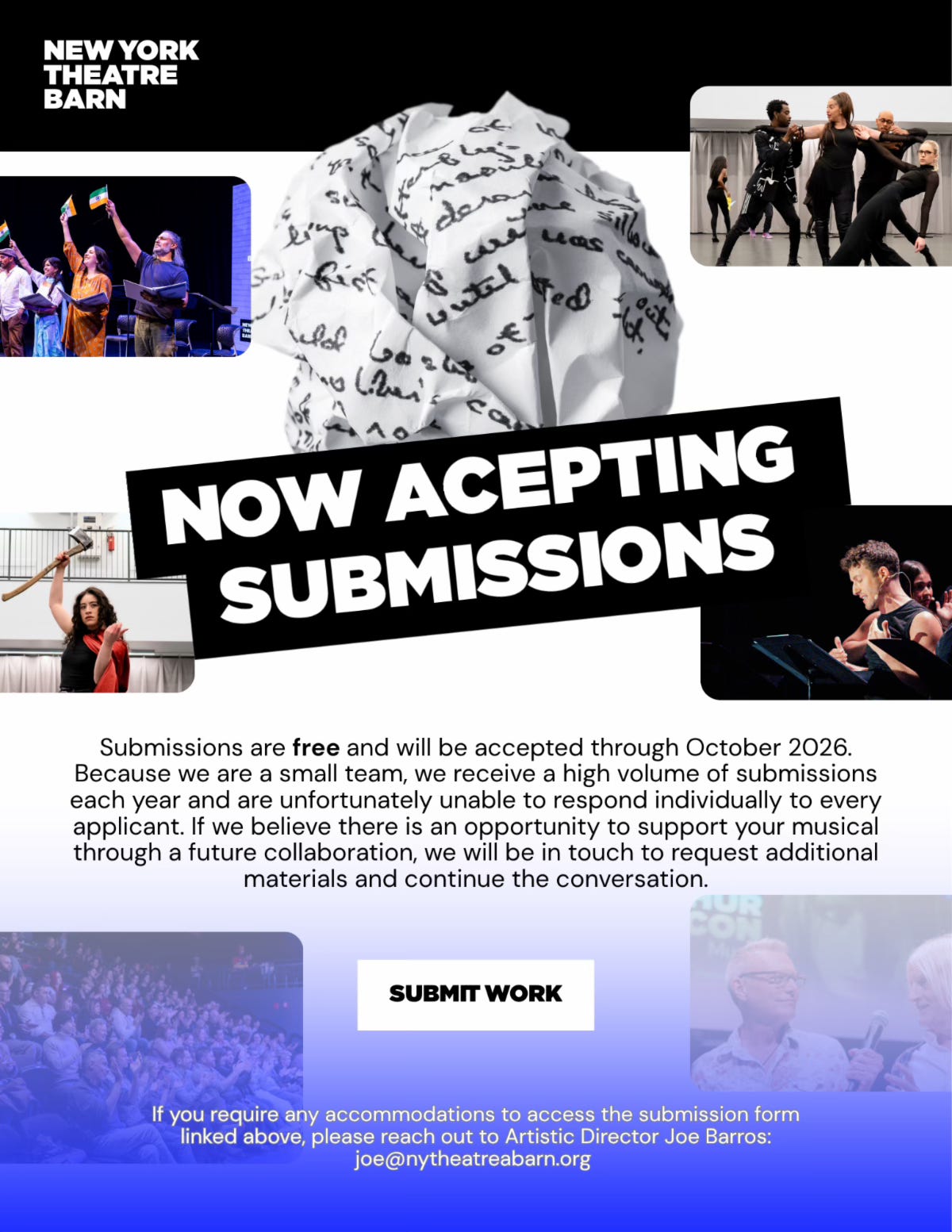
You can get more info at NewYorkTheaterBarn.org
Hi Emma, Thanks for sharing. I'd like to subscribe to paying status again. How do I do that?