
What Shaped You?
& Prompts from “Structure is NOT a Dirty Word”

I spent Friday and Saturday zooming an IFS conference (IFSCCC), and I could not tear myself away. What held my attention? A talk on how to help clients deal with the Norm Shock we’re living in; how to work with cultural and legacy burdens; attachment wounds through an IFS lens; and healing religious trauma. Epiphanies from beginning to end!
Laura Doney talked about high control religions as “the inner chisel that shaped you before you knew you were clay.” I was hooked. (No, she hasn’t written the book yet, but I hope she will.)
Let’s pause and consider this statement in any context: what shapes us? Our conditioning can be examined as a constellation of Parts. Any suffering it causes can be alleviated by getting to know the Parts of the system from Self Energy (or Soul) and creating the trust needed for healing.
From an IFS lens, Laura asked us to look at religion as a system filled with Protectors seeking safety, Managers deployed for obedience and moral control. With a controlling religion, like a controlling parent, we might organize our lives around fear of punishment, or fear of the loss of belonging, or eternal consequences. (Sometimes all three!)
How many of us, realizing we could not sustain our lives connected to our religion, left that religion and assumed that also meant we left God? Or how many of us left our family to save our own lives and then spent years berating ourselves for it?
No amount of thinking will change me in terms of how I feel, how I know myself, or how I feel about myself. My sense of who I am in the world is not another thought away; it’s a lifetime of habit and conditioning that creates my neural pathways. My relationship to God (or the Divine, or my lack of a relationship) can be changed because we know better now the nature of the brain.
While my brain is great at using language, there has never been a time when I could talk my way to healing and wholeness. The I of IFS stands for Internal - it happens inside.
This doesn’t mean that IFS excludes or ignores the Cognitive (thinking) Parts. All Parts are welcome in the IFS model. Often people show up so used to only working with Cognitive Parts, it takes time for the System to feel comfortable letting other Parts of the System have a say. Yes, Cognitive Parts offer us so much wisdom, and there is more to each of us than our cognition. True change from early conditioning needs to happen in a more holistic way.
IFS offers a brilliant model. For those who asked me to say more about how I found ease in my Jewish, Audhd, chronically ill body raised on shame and trauma, I can offer this. The first thing IFS did for me was help me get to know my Inner Critics and Perfectionists from a place of curiosity. These were the first Protectors I met. A Protector is an IFS term for a Part who performs a protective function.
An example: my Inner Critic used to berate me saying I was no good at whatever I wanted to do to save me from embarrassing myself. My Critic protected younger wounded Parts we call Exiles who had experienced a lot of shaming. My Inner Critic was super strong to keep me from feeling any of that shame.
Truth is, shame can be intensely painful, especially if you’re 4 or 5 or 7 years old. IFS doesn’t ever ask you to relive trauma. Instead we witness our Exiles’ trauma from our own healing Self Energy. In my 50s then, I was more than able to witness my young Exiles’ experiences and help them to unburden their shame.
Once the Inner Critic could see the young one unburdened and playing in a safe place, they were able to stop criticizing me and start cheering me on. Now that Part (full of kindness) helps me edit my work. They let me volunteer to go first. They don’t mind if I make an ass of myself or write badly. They let me take risks. They know I can handle it because the little ones who can’t are healed now.
There can be exponential effects to healing. As my system got quieter and less judgey, I had more access to Self Energy (aka Soul). We all have this inner healing mechanism, (though some of us need to learn how to access this). It’s how IFS works. It’s self-regulating, and it’s how I discovered a strong sense of the Divine within.
ASS CLASS!
I’ll be offering my Artist Statement Seminar (ASS Class) on Sunday July 12th from 2-5pm ET (check your time zone here). To register send $65 to me at my PayPal Link or via Venmo to Emma-Goldman-Sherman (8102 if they ask). (Yes, it’s cheaper, because life is harder right now.)
This is a deep dive into who you are and why you create and gives you the chance to express yourself on the page in a way that actually works! Because writing Artist Statements often makes us feel like asses, and this class fixes that.
ASS Class and I provide you with more than an artist’s statement, although you’ll get a draft of that too. And anyone who takes my ASS Class knows, I will respond to your statements forever, as you and the statements will grow and change. Class is capped and not recorded, so sign up soon.
THE PROMPT:
Because I have not had time to teach my 10 week Structure Course, “Structure is Not a Dirty Word,” created for anyone working with narrative but made with playwrights in mind, I want to give it to you in prompts bit by bit. You all have stories that must be told. Finding the best forms for those stories will change the world, and we all know the world needs changing.
We will start at the beginning. For many of you this will feel like review. But maybe I’ll take a few side trips. Before I got busy coaching, I had a sequel class planned. So we’ll travel together. Please feel free to engage with this, with me, by responding directly.
If this makes you wanna be a paid subscriber, super! I appreciate the help. And I will always make my content available to everyone/anyone who wants it.
Structure is NOT a Dirty Word
Think about your current relationship with structure. Are you strangers? Did you meet cute? Are you dating? Is it on again/off again? Or is it steady, permanent, boring? Is there so much unspoken between you? Would you like it to change? What would you want your relationship with structure to feel like?
Understanding where you are, as we begin, will help you see how far you can (and will) travel as we progress.
One of my favorite examples of using structure in a new way, a way that harnesses its power for how you tell your story, is Hannah Gadby’s Douglas. Hannah lets the audience know the structure at the beginning of her comedy special. As we watch, Hannah reminds us how the structure is happening and functioning all the way through. Hannah makes structure clear, but structure can also be the invisible scaffolding that holds up your story.
Learning about structure is really learning to trust your own fabulous unique instincts by giving you a chance to feel how to add it into or subtract it from the content you are creating. I’ll offer some vocabulary and some formal ideas, but you can also invent new formal ideas and constraints that works with or against your content.
So what is structure? It’s the container for the content. It’s what you build to hold your story. It can be as simple as beginning-middle-end or subject-verb-object. It can be as complex as La Sagrada Familia.
If you know the story you want to tell, can you tell it in 30 seconds? 1 minute? 5 minutes? How does it change as you pour it into those different-sized containers? What happens when you have 90 minutes? (Seriously, try it. We speak 150 words a minute. So for the exercise above, that’s 75 words, 150 words and 750 words.)
If you don’t know the story you want to tell, how comfortable are you living with uncertainty? If it’s easy for you, dive into that novel! If it’s hard, can you tell the story in 500 words, beginning to end?
If you need to know the complete arc, get it out in a block of prose and then work out how you want to structure it for the length it needs to be. At least you know where you’re going.
For me, I need to discover as I go. If I already know the ending, I’d be too bored to write it. Are you open to discovering the story as you go? Willing to maintain an open mind about structure as it is created as your story unfolds? Up to you and your temperament.
There is no right or wrong when it comes to how you do it. You can know ahead of time or make it up as you go. You can follow the templates in John Yorke’s Into the Woods, a brilliant book about structure, or you can create a new structure out of the themes or objects of your story.
Here is an exercise for thinking structurally. You can work from the project you’re working on or something new. Try a monologue. Use something from the world of the project (or the world of this character) to inform or influence how you write the monologue or even how the character exists as a character.
For example if you are Anton Chekhov struggling with a first draft of Cherry Orchard, try a monologue by Varya as a cherry (or maybe a cherry pit), or Madame Ranevskaya as a wilting cherry blossom, or Lopakhin as the axe. Use the things of the world to inform the characters. Form for function and function for form.
Adhere to the rules of a monologue (a reason to speak, to someone specific, with a want on the surface and a need underneath, diction particular to the character, taking an emotional journey). Structure it based on the object you to choose for this character - you might ask the character what they think they are, within the world of your play, instead of imposing it on them. Characters have the best ideas!
If the character says she is the lungs of the body of this play, how does that affect the lines you write for her? If you’re writing a monologue for Lopakhin as the axe, how does being the axe affect the structure of his sentences? His desire? His actions? What does he convey and to whom? If an axe aches for a tree, what is his diction, and how far can he go to get what he wants? Play! (and feel free to paste your monologues below)
Join Me In Brave Space
Work for a focused hour with help for when you can’t! Create in a supported community via Zoom. I offer prompts, grounding practices, & courage. After the hour, optional discussions about process & craft! Make deeper meaning. Find your groove. Restart after being stuck. Begin &/or bring your projects to completion.
Or use Brave Space as a body-doubling space to get other things done in community (write hard emails, clean out your closets, do taxes).
$5-25 suggested per session. 4x/week! On or off camera. No commitment necessary with lots of accountability! Drop-ins welcome. Try it!
Mondays, Wednesdays and Fridays at 12pm ET with Fast Feedback every Friday; and Sundays at 6pm ET with Sharing Second Sundays at 730pm ET EXCEPT this month when it’s the Third Sunday on June 21st because I’ll be performing during the day at Autistic Pride in Brooklyn on the 14th (before Brave Space), and I won’t necessarily have the bandwidth for a long night.
ACTUAL SCHEDULE: Next Brave Space is Friday 6/12 at 12pm ET. Brave Space Sunday at 6pm ET and Monday, Wednesday and Friday next week as usual at 12pm ET. Email or reply for a link!
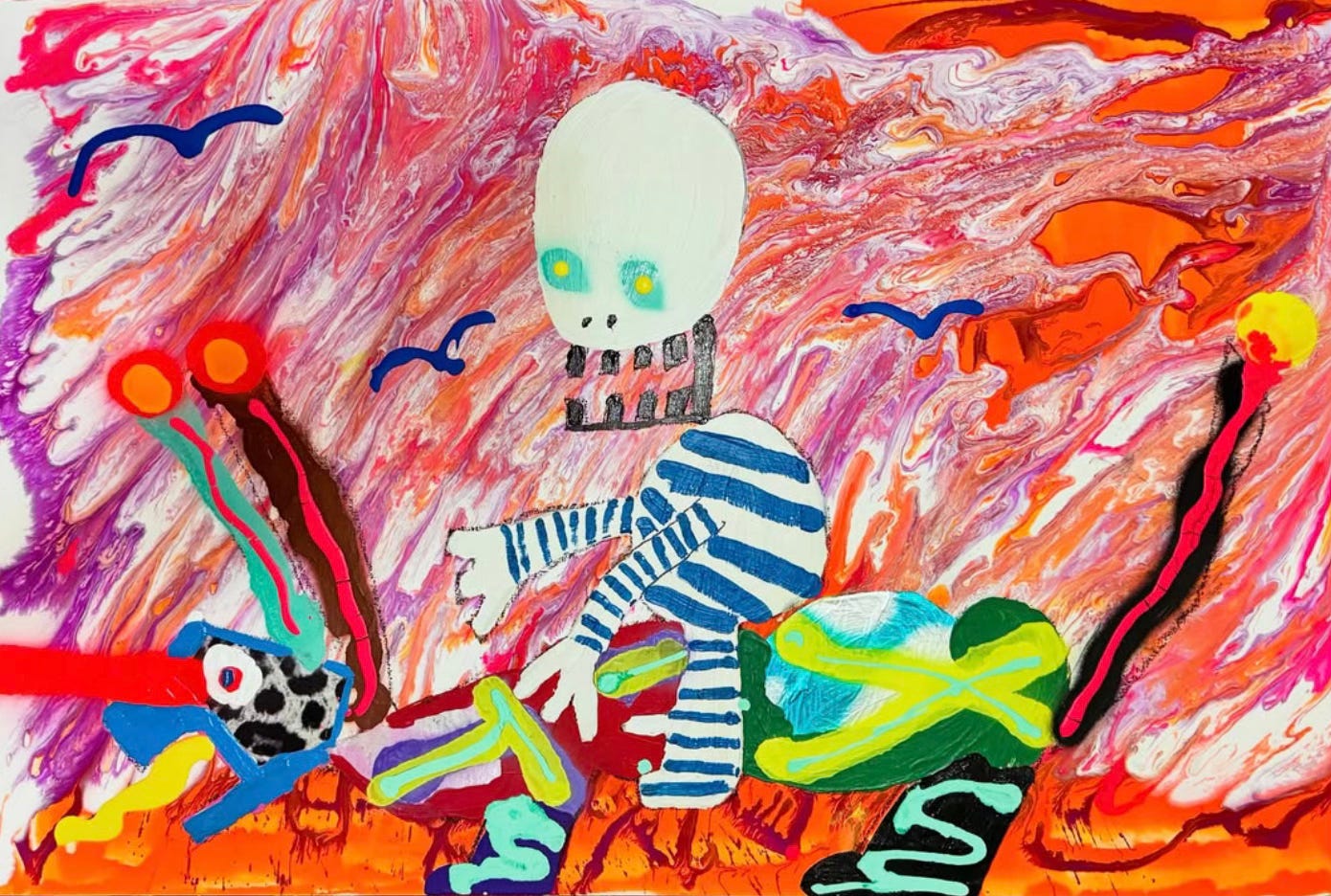
artwork by Scott Sherman at ScottShermanStudio on instagram
NeuroAffirming (NAF) Parts Work Group:
Meets Second Saturdays of each month (June 13th at 12pm ET - time zone converter here) to offer community, parts work experience and support for anyone neurodivergent (inclusive of Autism, ADHD, Audhd, OCD, cPTSD and more).
You do not need an actual diagnosis to participate. Run by Emma and Jess (Level II), both of us Audhd, we are creating non-pathologizing and anti-ableist Parts Work content for healing and ease in neurodivergent systems. Sign up for our link here. Sliding scale from $5-25/session, but no one will be turned away.
GO SEE:
Helen Banner’s beautiful new play In the Devil’s Hands in a super space on Long Island City (Queens)! Through 6/14.
Opportunities
NEW PLAY SUBMISSIONS are now invited for Athena Project’s Read & Rant event in September 2026! Athena Project amplifies the work of artists who identify as women, transgender and nonbinary, by helping them to connect with the audiences and professional opportunities that support their success. As a part of that mission, Read & Rant aims to help early and mid-career playwrights to share, showcase, and develop early-stage scripts, through collaboration with dramaturgs and connection with dynamic and responsive audiences. Submit by 6/30. Questions: contact Reilly Conlon at literarymanager@athenaprojectarts.org.
SUBMIT NOW to Urbanite Theatre in Sarasota, Florida, taking the first 300 scripts submitted (or 6/15) to this website for the 2026 Modern Works Festival.
PlayCo announces applications are now open for a two-week residency (October 24 - November 8, 2026) for two U.S.-based playwrights with Prague’s Švanda Theatre. Playwrights-in-residence will have the opportunity to collaborate on readings of their work translated into Czech, discuss their work in a public forum, and learn about the Czech theatre scene by meeting members of the local artistic community, seeing productions and visiting selected important venues and sites.
These residencies are open to U.S.-based playwrights with a strong interest in international engagement and exchange, who have experience including at least one professionally produced play at an established theatre, as well as other commissions, workshops, readings, or other work with professional theatres. Applications are open today, May 1st, will be accepted until 11:59 pm Eastern on Sunday, June 7.
Free Peer Coaching for Res Artist members. Res Artis is a worldwide network of artist residencies.
Women in the Arts and Media has a newsletter full of opps for stage plays and screenplays. Seriously lots here!
You can also sign up for Audrey Cephaly’s Substack, How to Playwright where she keeps better track of the opps.