
When Development Isn't Hell
And a Prompt for Developing Your Own Dramaturgical Senses

Often there’s no clear line delineating good vs. bad development. Things can go well until they don’t. We can think we’re safe until we aren’t. So I thought, since I just finished a really great developmental experience, I would point out what makes for a positive developmental experience. So we can all avoid “development hell.”
All the emphasis on the el sounds add to my own sense of “development hell” being more real than good development which is what we all want but rarely receive. So let’s look at healthy ways to move into and sustain a developmental process that will lead to a positive experience. We can call it Developmental Health!
WHY DEVELOP THIS
Before saying yes, I had to figure out why I wanted this opportunity and if it would be “worth it.” Even though we are all pressured all the time to be hungry for these opportunities, unless I could find a good reason to work on the play, I knew I’d be participating under false pretenses. Or I’d be spending time looking for something to work on in a time-constrained situation.
What would I work on? Was there something about this play that I wanted to change? Could I even get back into the mindset of the play that I wrote 9 years ago in order to be able to change things within the same strange tone of the play? Or could I envision another way to go about making changes?
Your experience may vary, but for me, when I write a play, I tend to feel very mother-bearish about it. This means, if you come too close to it, I will bare my teeth, rise up on my hind legs, growl and possible even swipe at you with my claws. I love my plays! I love their flaws! I don’t like being in rooms where people want to take my work apart to see how to improve it.
When I asked, “what would I work on,” my honest answer was that the play has always bothered me because it’s so white. While I love the play, the two characters (who are White Christian MidWesterners) are white in ways that make the play a play that doesn’t see color. It starts with them not seeing trans-people and having micro-aggressions against gay people. They grow by having to deal with their children's gender dysphoria and their parents’ toxic attitudes on gender that they have internalized. I needed to understand how a play can be aware of what its characters aren’t aware of, and that was what I wanted to work on.
Often these developmental opportunities are really about imposing a larger view on the play which can feel alien to a playwright who isn’t used to getting a lot of real attention (like me). It’s fine for me to write my “little” plays in my “closet” but when those plays exist in the world, they’re supposed to show up in their party pants! Development is about finding out what that means for your play.
Shifting my mindset into that wider lens can be helpful, and it can also feel daunting and scary. This is why it’s so important that development be healthy and not hell.
MANAGING EXPECTATIONS
Another way of saying, there must be safety. Nothing can be discovered without safety in the room. (Ok, danger can be discovered, but that’s all.) With safety in the room, the pleasure of failing can exist! And I do mean the pleasure of failing!
Theatre is a social art. Making a play takes a village. Being able to play with people is vital for the art to survive. What is being built needs to speak to a large group of humans in a specific way. This starts with the writer. First we must have the ability to be kind to ourselves. We must be able to feel confident enough with what we’re trying to do and our ability to do it (with support). Or else we aren’t open to the conversation that needs to happen for the play to develop.
BEING ON THE SAME PAGE
Knowing what you, as writer, want to focus on is vital. Having everyone on board is important so that no one is focused on fixing what ain’t broke. It’s best if this conversation happens before the work begins. Do you and the producers/director agree that what you think is important is the thing to work on? Will they support you in finding ways to work on that?
It’s not about getting the director and actors to solve the play’s problems for you. I told the producers how I felt my play was too white, and they offered to cast Black queer trans/nonbinary actors as the Dressers. This created the Black gaze I needed to inform the play, but then I had to figure out how to incorporate them so that they became an intrinsic part of the play.
This meant listening to the play with them in the room, and inviting everyone in the room including the stage manager to respond to what we were hearing. Then I started to bring in possible scenes. These included responses I’d heard from the Black Dressers. I wrote several different scenes, none of which worked.
BRINGING IN YOUR HEART
After a good night’s sleep, I challenged myself to write something completely different. I wanted to connect on a deeper level with the play. This is the kind of writing that I help people do in Brave Space and some of my classes. I grounded myself and wrote from my heart. Not cute funny awkward or wildly intense like the play itself, but a shift to a poetic fable for the Dressers to present.
The fourth or fifth version of this is now part of the play which is no longer a 2 hander with dressers but a play for 4 actors including the queer Black dressers who are preferably nonbinary and/or trans.
The final version wasn’t really working until the director asked me what I was trying to say in the last few lines. I talked it through with everyone in the room, and we all tried to rewrite the final line, changed it, tweaked it, and then assigned it, and then reassigned it until it worked. It felt good, like a puzzle piece falling into place. What I wish for you all.
THE PROMPT:
Why be your own dramaturg? You’ve written the Discovery Draft of the play, and you’re feeling amazed or drained or both, and you want someone, preferably a brilliant theatre godparent, to come and tell you what you’ve done and what to do next, but they haven’t shown up yet.
The next moment you despair and feel as if whatever you wrote is a disaster! You wobble between joy and despair until you settle somewhere in the middle feeling like maybe you could have a reading with really kind people and let them tell you what you’ve done.
But each one of them has a different opinion. Angela’s favorite scene is what Zak thinks you should cut! Bert says it’s about one thing while Yolanda says it’s about something totally different! (A form of development hell!)
This is why you need to be your own dramaturg. Create Development Health! I strongly suggest that before you put your play into a drawer and decide to try again with something else, you take 5 minutes, set a timer, and ask all your Critics and Judges to give you some space. Explain that this is a game Emma invented, and it’ll only bore them. Offer them beach chairs, a view, something to drink…
Then, start your timer, write out freehand what was it that you wanted to write when you started this project? Why did you start? What prompted / inspired you and does the play stay with that or has the play gone somewhere else?
Stretch! Breathe. Reset your timer. Whether you stuck with the originating image/idea or moved on to something else, without judgment, what do you think you have now? Write out the synopsis for what you think you have. Then write out the synopsis for what you want to have.
You might want to take some notes immediately. Or let things percolate, but not too long! Within a few days, you will be ready to write the First Draft. You might even be taking notes already!
The Discovery Draft is exactly that - a draft to help you discover what you’re writing. To turn it into a First Draft, notice what you’ve got. Read the Discovery Draft as if it’s new to you. Mark down the events. (Scroll down to the prompt for a good definition/explanation of events.)
Find the strengths and weaknesses of your script. Identify these for yourself clearly. One way to do this is to notice where there is a lack of events (typically this causes Narrative Sag). This will help you decide how to write the First Draft from a place of knowledge and power. It will also help you see the play’s intrinsic structure.
Are you writing a linear play or an episodic? Or is it epic, circular, spiral, or something else? What informs this structure and does the structure work for the story? Take notes on what exists and what you want the play to do. How do you want the play to function? You are building a machine that is sculpted to affect humanity (audiences). Use your power!
Then when you’re ready to write the First Draft, you have notes that will help you move through your Discovery Draft to honor the play itself and your vision. When you have it read aloud next time, you’ll be surprised to hear from Angela, Zak, Bert and Yolanda, how much better it is, and how pleased they are that you took all their notes!
BRAVE SPACE:
With prompts, grounding practices, & discussions and the creative process and craft! Brave Space invites playwrights, poets, painters, potters, novelists, memoirists, musicians & artists working in any medium to make meaning in a safe community. Begin and/or bring your projects to completion.
Or use Brave Space as a body-doubling space to get other things done in community (write hard emails, clean out your closets, do taxes).
$5-25 suggested per session. 4x/week! On or off camera. No commitment, drop-ins welcome. Try it!
Female & nonbinary folks welcome any time. All Humans welcome on Sundays.
Mondays & Wednesdays at 12pm ET; Fridays at 12pm ET w/fast feedback; and Sundays at 6pm ET with Sharing Second Sundays at 730pm ET (that means December 14!!!) Email or reply for a link!
ACTUAL SCHEDULE: I’m in rehearsals for a reading of Man & Wife w/an amazing cast directed by Mêlisa Annis produced by Clutch Productions! Next Brave Space Wednesday 12/10, then Friday 12/12 and Sunday is Sharing 12/14!
NeuroAffirming (NAF) Parts Work Group:
Meets Second Saturdays of each month (December 13th at 12pm ET - time zone converter here) to offer community, parts work experience and support for anyone neurodivergent (inclusive of Autism, ADHD, Audhd, OCD, cPTSD, and more).
You do not need an actual diagnosis to participate. Run by Emma and Jess (Level II), both of us Audhd, we are creating non-pathologizing and anti-ableist Parts Work content for healing and ease in neurodivergent systems. Sign up for our link here. Sliding scale from $5-25/session, but no one will be turned away.
artwork by Scott Sherman at ScottShermanStudio on instagram
Opportunities
RHONDA MUSAK is offering her yearly LEAP with PASSION Workshop for making your 2026 all you want it to be. It has helped me SO much! I highly recommend it! If you are looking for a great way to achieve your goals in 2026, leap with passion! Register here!
Due 1/5/26 The Relentless Award! For an unproduced full-length play. More info here.
Dark Nature Poetry and Literary Fiction Anthology for Wildlife Protection has a call out for Dramatic Monologues and Fiction (they have enough poetry), and there is more information on what they seek at their Facebook group. They seek dark lit combining beauty and gloom. This can be about plants and/or animals. It may also involve people as observers to Nature, their yearning for connection or grief at estrangement from it.
My colleagues at the Grief Dialogues are seeking short plays or pieces/stories centered on 9/11, its aftermath, or themes adjacent to that day (such as resilience, community, or collective grief). You can submit here for a production to be presented during the week of September 7, 2026 for the 25th anniversary of 9/11.
New York peeps! NYFA offers a year-long Emerging Leaders Program in Arts Administration and Management. Apply by 12/17/25! Please share with those you know working on this side of the arts!
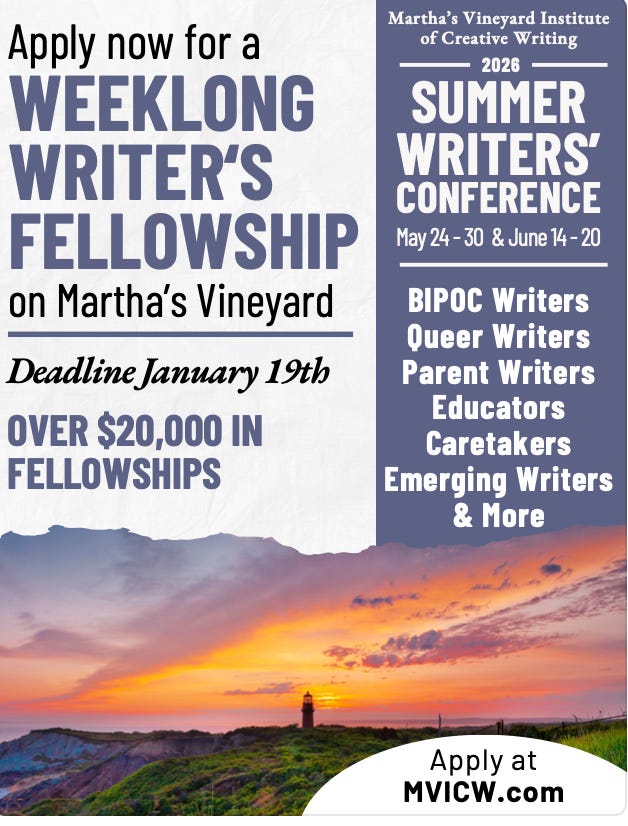
DUE 1/19/26 - Summer Writers’ Conference on Martha’s Vineyard 2026! Fellowships include full tuition & lodging! Queer Writer Fellowships open to all queer-identified writers ages 18+, and ALSO full fellowships for Parent-Writers, Writers of Color, Teachers & Educators and two brand new fellowships for Full-time Caregivers and Emerging Writers. We are offering over $20,000 in Fellowships to attend, and the deadline for application is Jan 19th, 2026.
Amazing People Doing Amazing Things:
If you want to be listed here, please let me know what you’re up to and include your links!
Jess Pearce & I made these IFS experientials on Insight Timer. Enjoy here.
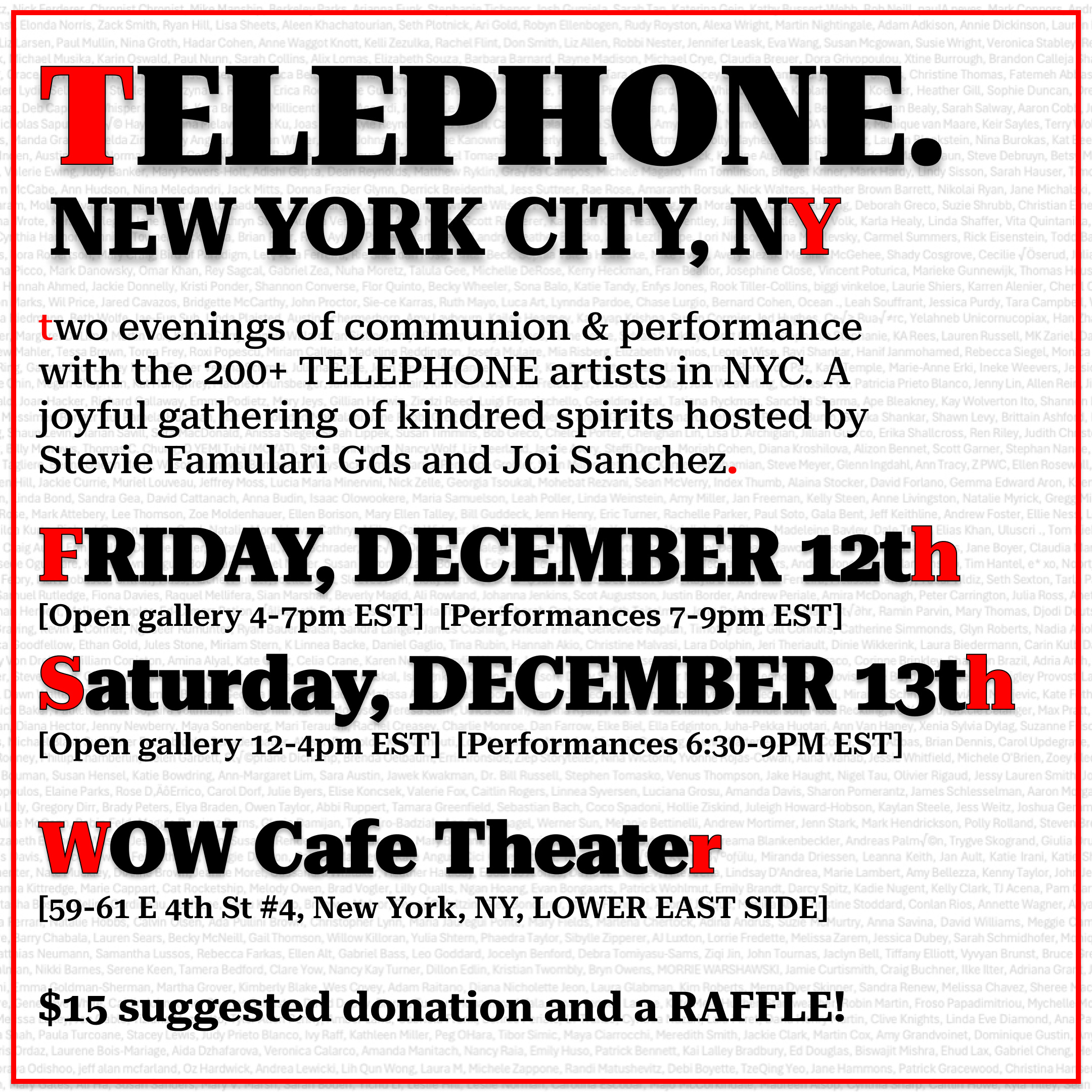
I’ll be performing a poem in person with Telephone in NYC at WOW Cafe 59-61 E 4th Street on Saturday, December 13th. And Telephone art installation will be at WOW all weekend.
POLITICAL ACTION:
I suggest, instead of feeling helpless in the face of the news, get up-to-date on issues important to you. Seek out Substacks or youtube providers or other newsletters and outlets beyond the corporate hegemony. Here are some ways to readjust your focus.
Get Involved:
What you need to know about ICE.
Fight for the National Endowment for the Arts (NEA).
Writers for Democratic Action.
READ/SUBSCRIBE:
Chop Wood, Carry Water - a substack by Jess Craven that helps me focus on political action and includes good news to help sustain us!
ABORTION EVERY DAY a substack by Jessica Valenti - support real research about what’s really happening. MEN, this is scary shit, and your support is needed and appreciated!
THE CRUCIAL YEARS a substack by Bill McKibben - climate change and ways to understand it and to actually do stuff about it.
ERIN in the Morning, by Erin Reed - news about the trans community.
The Intercept, 972mag, Aljazeera, and Mondoweiss - independent news.
DONATE:
Give to the Middle Eastern Children’s Alliance
Give to Doctors Without Borders
6 Ways to Support Palestine
Donate for Civilians in Palestine
As someone who has worked in new play development and kept up with it over the years even as I moved into academia, I'm REALLY interested in this conversation. I would love to hear from people who have had a positive experience. It seems like we had some good times and good work at the Oregon Shakespeare Festival. And those who've worked with the O'Neill seem to have had productive stays. It would be terrific if people had a chance to give feedback in a way that was anonymous. Anyway, thanks for this entry, and I also love the prompt!!